

Sent to Italy circa 2020. Published it today.
CONCEPT SKETCH here: [LINK]
The City, the Lagoon, and the Sea
Salvation Archaeology
Venice is losing the battle to save itself. The challenge is the nature of the location. Imagine re-imagining the location — by befriending the sea. This could be the key to everything.
(A) Current Solutions
The historic city faces the rising sea. The response has been barrier engineering — the MOSE system, flood barriers, and remediation. The sea is the enemy to be held at bay.
(B) The “Living” Inner Lagoon
Instead, imagine an engineered lagoon city, at the heart of an inner lagoon — built inside the natural lagoon: The concept proposes that Venetians stop fighting the sea and start designing with it. The lagoon inside the wall is not a compromise. It is deliberate. It is to accept the nature of the sea as a buttress of the city, to:
-
- Protect the historic city from sea level rise
- Protect the sea from cruise ships wash destabilizing the historic area
- Prevent further erosion of the canal walls
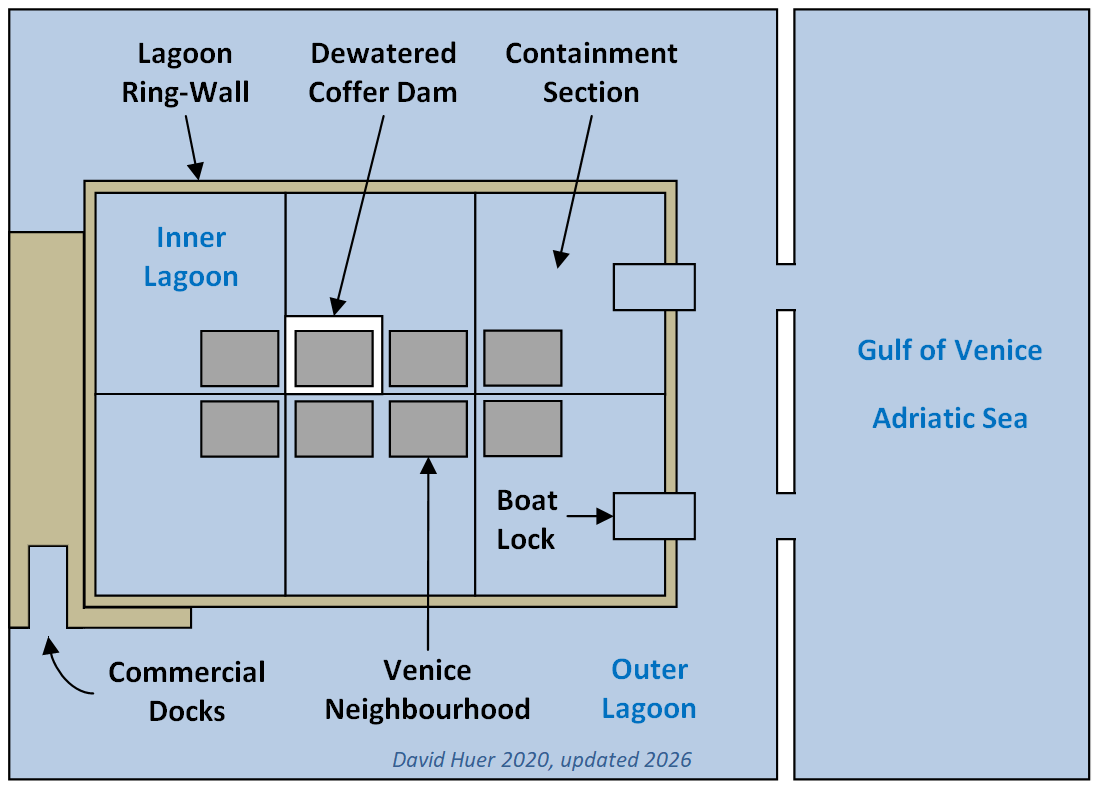
Lagoon Engineering Schematic
The Ring-walled Fortress Lagoon
The sea is the neighbour, not the enemy held at bay. In a place where it is hard to hold back the living sea from the living lagoon–instead build a ring-wall around the city, to make it a fortress like Mont-Saint-Michel.
The city becomes the walled-city-inside-a-lagoon-inside-the-lagoon.
The Ring Fortress
The city must be protected to shield it from further external tidal pressure. The Ring-Wall can be built first, to stabilize the water levels of the inner lagoon. It’s the precondition for everything else to work correctly.
Neighbourhood Segments
-
- The Ring-Wall provides the structural boundary that allows each neighbourhood section to be treated as a contained engineering work zone.
- The lagoon inside the fortress can be sectioned off, so that each neighbourhood — and cofferdams within — can be dewatered.
- The Ring-Wall can be built with pre-buttresses ready for inner lagoon section construction.
- Dewatering creates the means stabilize each section’s undercroft.
- Without the ring wall, the dewatering is fighting the sea directly.
Marine Economy
Supply and cruise ships can dock at a dedicated harbour and wharves along the Ring-Walls, which support rail and road infrastructure to whiz residents and visitors around the city.
Tidal Economy
The Inner and Outer Lagoons need seawater exchange to be living systems. And the Inner Lagoon especially must maintain the ecological economic circular ecosystem.
Tidal Hydropower: This is the self-powering component of the “Lagoon-Lagoon-Sea Ecosystem” (“Laguna-Laguna -Mare-Ecosistema“):
-
-
- Sluice gates engineered into the Ring Walls — a modern version of the aboiteaux sluice gate systems that transformed 17th C Acadia into the economic powerhouse in its day; able to export wheat to France
- Renewable energy infrastructure delivering power from the tidal differential –> The tide pumping life through the system.
-
The construct becomes an engineered palindrome:
-
-
- Acadian Aboiteaux Sluice Gates:
- Standard functions: The sluice gates allow for water to exit and enter.
- Storm/Surge Event: Pressure forces the gates shut.
- Acadian Aboiteaux Sluice Gates:
-
The Adhesion “Piston”
-
-
- Today’s lagoon is cut with deep ship channels: There is not much depth difference across the lagoon, but ship channel outflows are fast-moving.
- Conceivably, the outflows will act as siphons to capture sluice gate discharge through adhesion, fluid entrainment and the Venturi effect.
- In paddling, where these sections of river go past an outfall or eddy, the flow creates a pressure drop (Bernoulli’s Principle).
- Could the deep ship channels function as a “hydraulic vacuum” to “drag” sluice discharge at low tide?
- Could the combined effects act-to-activate active recharge, instead of the slow movement that could be expected to occur in a shallow lagoon?
-
Reverberation Walls
-
-
- Tesla Valve Outer Barriers: During tidal rise, and a storm surge, the ocean could reverberate against the Ring-Wall.
- Could Tesla Valves be arrayed out from the main wall, to break up wave energy using Tesla’s nested, curved loops constructs?
- Could nearby shores and islands have “reverberation walls” to further dissapate flow energies?
-
Natural Economy
The seabed and sea of the Inner Lagoon continue to be productive.
-
-
- The Inner Lagoon becomes systematically measurable, using the “Proximity of Desire” (POD) method to value public real property and the commons.
- In this construct, the value of Nature’s services become economically measurable.
- This creates the means to calculate the hybrid productivity of Nature + Human.
- This foreseeably becomes a way to evaluate the economic impact for closed systems such as off-Earth colonies.
- Perhaps the European Space Agency (ESA) could come aboard?
-
Small Vessel Elevators
The Ring-Walls can contain small vessel elevators, or stepped lift locks, to create access to the inner lagoon (similar to car elevators, or the hydraulic lift locks on the Trent-Severn Waterway in Canada). The elevators are not decorative. They address the engineering problem of small vessel access to-and-from a walled lagoon harbour, from the outer lagoon’s variable water levels. The hydraulic lift lock is similar and is well-understood— the Trent-Severn system delivers the solution in Ontario for over a century. This type of waterborne commerce infrastructure technology is well-understood. It uses gravity, and can be applied here.
Restoration Archaeology
The Venetian undercroft has never been systematically excavated because the water table has always prevented it. A tidal city cannot restore itself when tides enter the city every day. This is where sectioned dewatering accomplishes the formerly intractable. Each neighbourhood becomes a contained engineering project. Dewatering happens section by section. The archaeology proceeds simultaneously — which means the engineering investment produces cultural value as well as structural value. The city obtains the opportunity to systematically investigate the undercroft history of itself, as it stabilizes itself.
To see what’s underneath. Imagine all the layers.
Controlled dewatering creates the means to execute systematic archaeological excavation instead of emergency salvage. The engineering and archaeology will happen at the same time, over several decades; neighbourhood-by-neighbourhood; segment-by-segment; cofferdam-by-cofferdam; without risk of inundation with every tide. The archaeologists get a stable dry environment. The engineers get time to work carefully — not race the tide. The neighbourhood gets its history documented as the infrastructure is stabilized.
Rising Title
Legal framework innovation for sea level rise property adaptation, proposed to:
-
- Tangier Island VA (USA), St. Pierre et Miquelon (France), here proposed for Venice
- Connects aboiteaux traditional tidal management technology to contemporary coastal resilience engineering
- [ 1-page PDF: https://davehuer.com/wp-content/uploads/2018/10/dhuer-tangier-island-june2018b.pdf ]
The larger challenge is the loss of the communities of the outer lagoon as the outer defences fail and sea rises. Could “Rising Title” be key to the survival of seaside communities?
This is a proposed property title correction for land lost to the sea. Under current law, submerged land reverts to the State as foreshore/inshore. The people who built their lives and livelihoods lose everything with no compensation and no continuing relationship to the place they occupied.
Residents become refugees. Local communities just stop. They take their loss with them. “Rising Title” is much better. Seabed title rising to legal recognition as the land is submerged. Rising Title can build the world we need to protect the livelihoods of every family and their estates.
Regenerate
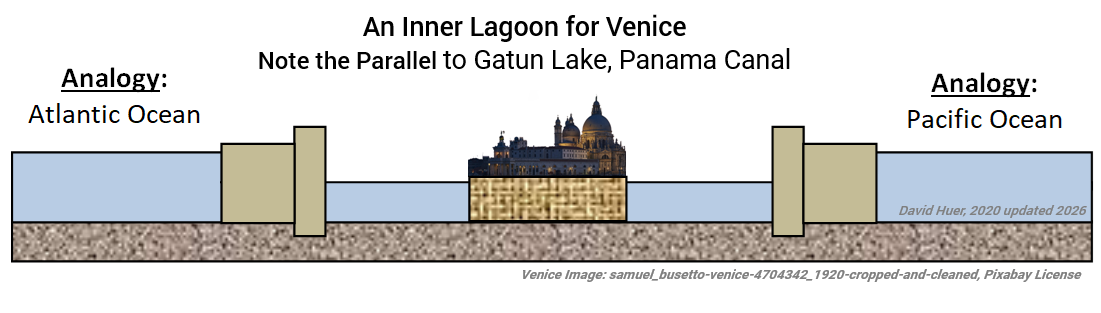
Venice – The Inner Lagoon as Gatun Lake
The project starts by building the cofferdams for the Ring-Wall…and this is where the archaeology begins. Recovering artefacts from the Neolithic to Now. The Venice lagoon has been continuously occupied by human civilization. All of it. The Ring-Wall foundation cofferdams are the first opportunity to systematically excavate 10,000 years of the stratigraphic record. Not through emergency salvage archaeology. Not through accidental discovery. Instead, through a process that is deliberate, systematic, and measured. And then, within each dewatered cofferdam, within each section, within the Ring-Wall.
What is the Ring-Wall? A fixed barrier with a extendible upper wall – and sluice-gates below, to keep the Inner Lagoon reinvigorated.
-
- A living outer wall that creates two adjacent water levels
- Converting the Inner Lagoon–the entire city–into a Ship Lock that connects two lakes
- Exactly like Gatun Lake on the Panama Canal
Summary
This is not remediation. It’s a proposal for transformation. This is traditional technology — the fortress wall, the dyke, the sluice gate and lift locks — applied using modern materials and systems, at the scale required to address the challenge. The Ring-Wall is the Venetian equivalent of the aboiteaux system that transformed the sea-marshes of 17th Century Acadia, Nova Scotia into farmland. The engineering antecedent of the solution that Venice could use — in our time and for centuries to come. The archaeology of Venice invites the engineering marvel. Centuries of discovery, recording 10,000 years of Mediterranean civilization.
Befriending the sea
This could be the key to everything.
Image: Laocoön and his sons, Source/Photographer: LivioAndronico (2014)
Vatican Museums, CC BY-SA 4.0 <https://creativecommons.org/licenses/by-sa/4.0>, via Wikimedia Commons
https://commons.wikimedia.org/wiki/File:Laocoon_and_His_Sons.jpg
Image: Image: Venice, by Samuel_Busetto: https://pixabay.com/photos/venice-sunset-gondola-water-italy-4704342/
– end –
Pingback: De-Laocoöning-the-Lagoon: Salvation Engineering for Venice |